


Modernizing an enterprise application can give a huge boost to performance, security, and user satisfaction. However, there is a catch: a modern application is only as useful as its ability to get along with the rest of the enterprise.
An organization may swap out a legacy CRM, move its ERP to the cloud, or revamp a customer portal, but still be stuck with the same old problems – duplicated data, manual workarounds, disconnected workflows, and reports that can’t seem to agree on anything.
That’s the enterprise application integration problem.
Whitepaper – Static, Server, or Hybrid: Choosing the Right Rendering Strategy for Modern Web Apps
This whitepaper provides engineering leaders with a clear framework to evaluate Static Site Generation (SSG), Server-Side Rendering (SSR), and Hybrid strategies so they can optimize performance, data freshness, and cloud costs in modern web applications.
Modern Applications Can Still Create Old Problems
Enterprise environments aren’t and probably never will be one size that fits all. These days there’s usually a mix of different platforms at play – ERP, CRM, HR, finance, analytics, customer-facing applications, databases, SaaS platforms and a whole bunch of legacy systems still chugging along.
The problem with trying to modernize each system one by one is that it can end up increasing the numbers of different tech stacks that need to communicate and be able to work together.
It is getting pretty clear just how big this problem is. MuleSoft’s 2026 Connectivity Benchmark shows that 45% of companies use 1,000 or more applications, and 95% of IT leaders say that integration is a major hurdle when it comes to implementing AI effectively.
Meanwhile, IBM points out that 70% of organizations are using more than one data integration tool, with half using at least three, which of course adds even more complexity and expense to the picture.
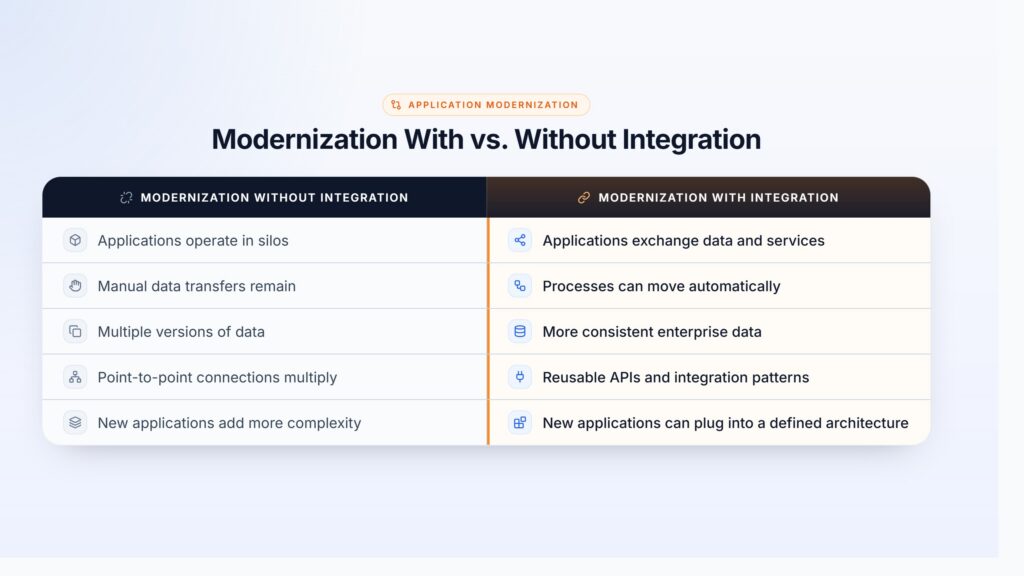
The bottom line is that when it comes to application modernization and integration strategy, they need to move forward hand in hand.
Moreover, integration is way more than just getting two systems to communicate with each other. Integration is often reduced to just linking up two applications. But on a scale, within an enterprise, it is a lot more complex.
At the end of the day, the real objective is to create a connected application ecosystem where data and business processes flow smoothly from one system to another without any issues. That might look like:
- Opening up your business capabilities so other systems can use them via APIs
- Tying your legacy databases in with your modern applications
- Synchronizing CRM system with ERP and customer-facing systems
- Using event-driven architecture where speed of response is crucial
- Establishing governance around APIs, data, security, and access
This matters because integration on its own consumes significant IT capacity. MuleSoft recently found that on average, IT teams are spending a whopping 36% of their time designing, building and testing custom integrations.
That is time that could be better spent on something more useful, like building a new product, or automating, or generally making the customer’s experience better.
A Better Approach to Enterprise Application Modernization
Before even thinking about modernizing an individual application, enterprises should ask three key questions first:
What’s this application tied up with? Take time to figure out which databases, APIs, business processes, the other downstream systems and upstream data sources it relies on.
What will depend on the modernized application? A replacement system may introduce new APIs, data structures, authentication methods, or integration requirements.
How should the connection be designed for the next application? A one-off connector may solve today’s problem while creating tomorrow’s technical debt. Reusable APIs, integration standards, and clear ‘who’s in charge’ models will make things easier.
Red Hat’s 2025 research reinforces the challenge: 51% of respondents cited integration with existing systems and software as an automation hurdle, while 42% reported using 26 – 50 IT tools and another 28% used more than 50.
Where Innovatix Fits in the Bigger Picture
This is where Innovatix’s Enterprise Digital Engineering comes into its own, because it is so much more than just building applications alone.
Innovatix Technology Partners is involved in lots of different areas like application modernization, APIs, microservices, cloud-based platforms, and modern back-end systems that help organizations take the first steps towards replacing fragmented legacy systems with a more cohesive digital environment.
Integration also cannot stop at implementation. Through Managed Services & Enterprise Support, Innovatix supports applications in production, which means keeping up with things like API integrations, database connections, maintenance and monitoring – and finding new ways to keep the system up to date and running smoothly.
The Bottom Line
Modernizing individual applications up to date can do some good, yes. But if you want to get the best out of your technology and your business, then you have got to look at how all those different systems interact with each other.
What you need to aim for is creating a single technology ecosystem where all your applications, data, and processes can work together without introducing crippling complexity every time the business goes through a change. That’s the difference between modernizing your applications and transforming your whole enterprise.
Whitepaper – Static, Server, or Hybrid: Choosing the Right Rendering Strategy for Modern Web Apps
This whitepaper provides engineering leaders with a clear framework to evaluate Static Site Generation (SSG), Server-Side Rendering (SSR), and Hybrid strategies so they can optimize performance, data freshness, and cloud costs in modern web applications.